What to see in Fez: Morocco's largest medieval medina
A walk through the Fez medina in the order we do it: Bab Bou Jeloud, madrasas, tanneries and viewpoints, with honest notes on official guides, fake guides and smells.
Published on · 11 min read
Almost everything worth seeing in Fez is inside Fez el Bali, the old medina: Bab Bou Jeloud, the Bou Inania Madrasa, the Al Attarine Madrasa, the outside of Al Qarawiyyin University, Seffarine square and the Chouara tanneries. You need a full day with a guide for that. With a second day you add Fez el Jdid, the Mellah and the viewpoints over the city.
Fez is Morocco's oldest imperial city and its medina, a World Heritage Site, is one of the best-preserved medieval centres in the world. No cars circulate inside: goods are still moved by donkey, mule or handcart. For us it is the city that best explains the country's history and crafts, and also the one that most disorients first-time visitors. So instead of a list, we describe the walk the way we do it with our travellers, from top to bottom, with what tends to go wrong on each stretch. The basics are on our Fez destination page and the context for the country in the Morocco travel guide.
How Fez is laid out
The city has three parts. Fez el Bali is the medina founded in the 9th century, on the slope of a valley, and it holds almost everything you'll want to see. Fez el Jdid, "new Fez", was built by the Merenids in the 13th century and contains the Royal Palace and the Mellah. The Ville Nouvelle is the modern French-era city, with avenues, cafés and the large hotels.
What you need to know about Fez el Bali is that it is on a hill. The top is Bab Bou Jeloud; the bottom is the river and the Bab Rcif area. Everything is easier going downhill, so we always go in at the top and come out at the bottom, where a taxi takes us back to the riad.
Early morning at Bab Bou Jeloud
We meet the guide at the Blue Gate, Bab Bou Jeloud, first thing in the morning. It is the most photographed entrance to the medina: blue tiles on the outside, green on the inside. If you want the photo without people, this is the moment.
The two main streets start here, Talaa Kebira and Talaa Seghira, which run down almost in parallel towards the centre of the medina. If you ever get lost, look for either of them: everything that goes downhill ends up on one of them.
This is also where you'll see the most fake guides. Young men who ask where you are from, tell you the madrasa is closed or offer to take you "to the tanneries, my friend". If you already have a guide, they leave you alone straight away. If you are on your own, don't argue, don't explain yourself and keep walking with purpose. Saying you already have a guide is usually enough.
Bou Inania Madrasa
A few minutes down Talaa Kebira. It was built by the Merenids in the 14th century and is one of the few religious buildings in Morocco that non-Muslims can visit. The marble courtyard, the stucco, the carved cedar wood and the old water clock on the façade opposite take about 40 minutes.
Before you get your camera out, sit for five minutes at the side of the courtyard and look up. That way you see the details that get lost in a photo.
Down Talaa Kebira
Between Bou Inania and the centre of the medina there is a long stretch of street with grocery shops, neighbourhood bakeries, sweet stalls and butchers. This is the first place where the medina smells strong, and it isn't the tanneries: at the butchers the meat hangs in the open air and now and then you'll see a camel's head on the counter. Some people find it funny and others find it turns their stomach; better to know beforehand.
When you hear "balak" behind you, step to one side: a loaded donkey or a handcart is coming, and it won't stop. With young children, hold their hand on this stretch.
You'll pass the Fondouk Nejjarine on one side of the street. It is a restored old caravanserai that now houses the Wood Museum, and it has a terrace with views over the rooftops. A half-hour visit fits in here or on your way back in the afternoon.
Zaouia of Moulay Idriss II
The shrine of the city's founder is one of the most revered places in Morocco. If you are not Muslim you can't go in, and in the surrounding streets you'll see a wooden bar across the lane at a certain height that marks the limit. What is interesting here is the atmosphere outside: stalls selling candles, incense and sweets for the pilgrims. Ten minutes, in silence, and without photographing people at prayer up close.
Al Attarine Madrasa and Al Qarawiyyin
The Al Attarine Madrasa is next to the perfume and spice sellers' souk. It is smaller than Bou Inania and its decoration is even finer. Allow half an hour. When the upper floor is open, you can see the green roofs of Al Qarawiyyin from the top.
The Al Qarawiyyin University and Mosque was founded by Fatima al-Fihri in the 9th century and is considered one of the oldest educational institutions in the world still operating. Non-Muslims can't go in, but through one of its open doors you can glimpse the courtyard. The guide will take you to the one with the best view. Its library, restored a few years ago, holds very valuable manuscripts.
Seffarine square
Very close to Al Qarawiyyin, the coppersmiths' square is one of the noisiest places in the medina: craftsmen hammering copper pots and trays in full view of everyone. It is a good spot to stop for a drink. If you want to photograph a craftsman, ask first; many say yes, some don't.
Chouara tanneries
We get here before lunch, because there is more activity in the pits in the morning and the sun isn't fierce yet. It is the most famous image of Fez: dozens of stone pits full of dyes where hides are worked as they were centuries ago.
You see the tanneries from the terraces of the leather shops that surround them. Going up is free or costs a small tip, and then they show you the shop. Nobody makes you buy, but the sales pitch comes, and it is persistent. If you don't want anything, say so early and politely.
About the smell, let's be honest: it is strong. The hides are treated with products that smell a lot, and in summer it is much more noticeable. They'll give you a sprig of mint for your nose. Most of our travellers get used to it in five minutes; the odd one can't stand it and goes back down straight away, and that's fine.
Near the tanneries is where most people will tell you "you can't go this way" or "today is the Berbers' last day of work". It isn't true. It is to take you to a particular terrace and charge you for it.
Eating in the medina
We have lunch at a restaurant in the medina or at a riad that serves meals. Order pigeon pastilla, the speciality of Fez: filled pastry, sweet and savoury at once, with cinnamon on top. If the mix doesn't appeal, the chicken pastilla is milder. There are more dishes in our guide to Moroccan food.
In the afternoon you can go back to the craft souks with less hurry, or retreat to the riad. Fez is more tiring than Marrakech, because of the slopes and the constant attention it takes to walk lanes a metre wide.
The craft souks of Fez
Fez is Morocco's craft capital. You'll see ceramic workshops, agave silk weavers, embroiderers, slipper makers and tinsmiths. For leather and blue-and-white pottery, it is the best place in the country to shop.
An honest note: almost all guides, including official ones, take their groups to a cooperative or shop where they earn commission. It isn't a scandal; it is how it works all over Morocco. What we recommend is telling the guide at the start how many shop stops you want, even if that is none. When we arrange the guide ourselves, we ask for this beforehand. And in any shop, ask the price and compare in two or three before you negotiate. In our article on customs and etiquette in Morocco we give some pointers for haggling.
Sunset at the Merenid Tombs
In the late afternoon we go up by car or taxi to the Merenid Tombs, on a hill north of the medina. The tombs are in ruins and there isn't much to see in them; what you come for is the whole medina at your feet, with the minarets and rooftops lighting up in the last sun. It is the moment people finally understand the size of what they have walked.
Borj Nord, a nearby fortress with an arms museum, gives a similar view. Borj Sud, on the hill opposite, is less crowded. If you are staying in a riad with a terrace, ask to go up: many have views, and from there you hear the calls to prayer from dozens of mosques at once.
Second day in Fez el Jdid and the Mellah
The Royal Palace
You can't visit the inside, but its seven golden bronze doors, with tiles and cedar wood, are one of the classic photos of Fez. Go early, when the light is better and there is hardly anyone around. Twenty minutes is enough.
The Mellah
The Jewish quarter of Fez is one of the oldest in Morocco. What stands out are the houses with balconies open to the street, very different from the closed façades of the medina. You can visit the Ibn Danan synagogue and the Jewish cemetery, with its whitewashed tombs. For both, at a strolling pace, an hour and a half is enough.
Meknes and Volubilis
If you have a third day, the classic excursion is Meknes, another imperial city, and the Roman ruins of Volubilis, with mosaics on the floors of the houses. They are done together in a day by car. If you are heading north, you can also see Volubilis on the way to Chefchaouen.
Fez depending on who is travelling
For a couple with two days, what we describe above is exactly what we suggest: on the first day, the medina with a guide; on the second, Fez el Jdid in the morning and the afternoon free to go back to the souks.
With children, the guide is even more useful, because the narrow lanes and the donkeys unsettle little ones a bit and it helps to move quickly between the places they enjoy, like the coppersmiths' square or the tanneries. A riad with a large terrace gives them somewhere to run around afterwards.
To anyone travelling alone, especially women, we say the same as to everyone, only with more reason: a guide on the first day, clothes that cover shoulders and knees, and don't accept company you haven't asked for. Fez is more conservative than Marrakech and the pestering, when there is any, is more noticeable.
If you have limited mobility, the Fez medina is difficult: slopes, steps, polished stone underfoot. Walking it from top to bottom with a taxi waiting at Bab Rcif makes it more manageable.
And if you have very little time, for example one night passing through on a route to the desert, stick to Bou Inania, Al Attarine, Seffarine square and the tanneries. That is three or four hours with a guide.
Day trips and routes from Fez
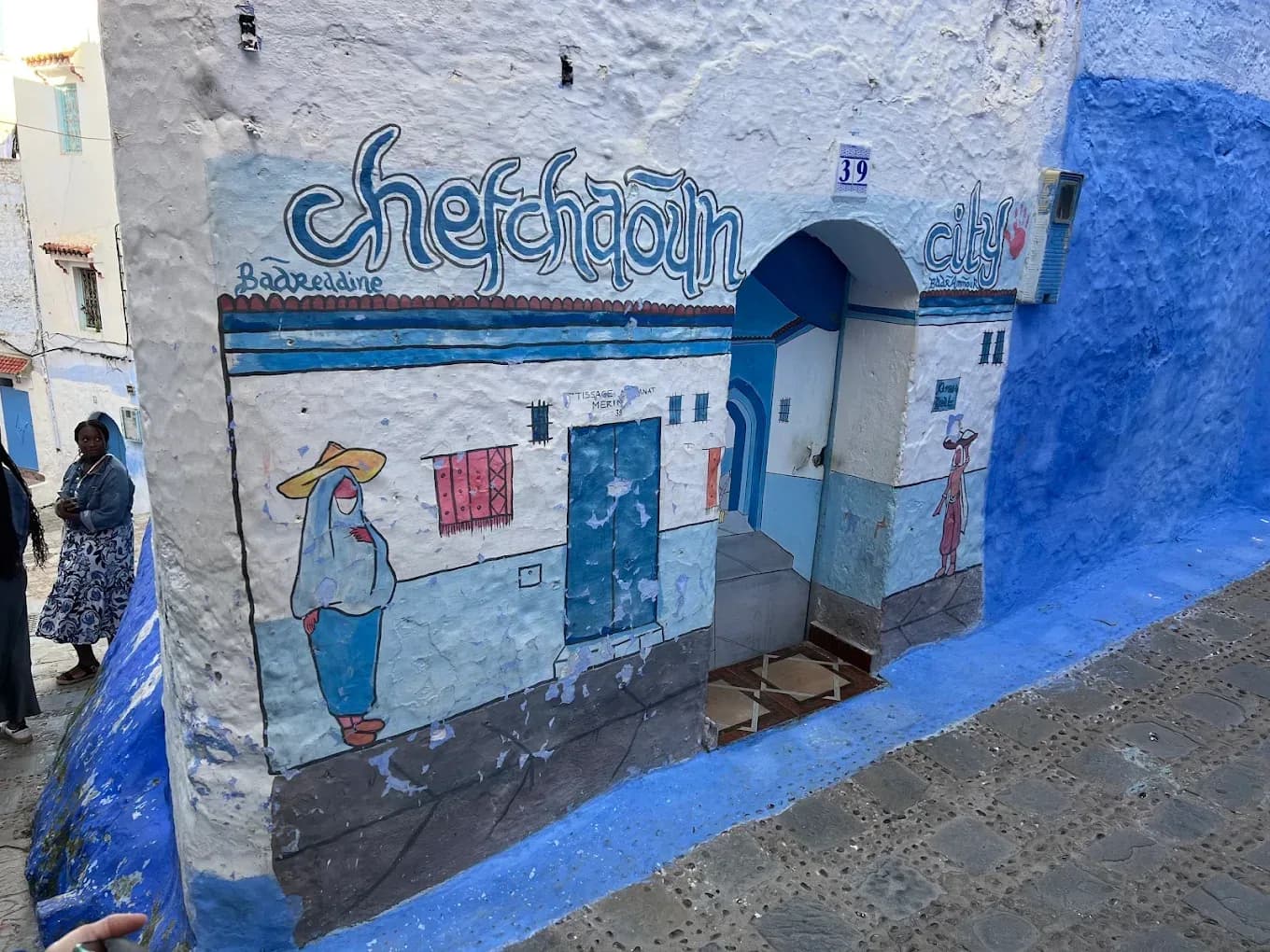
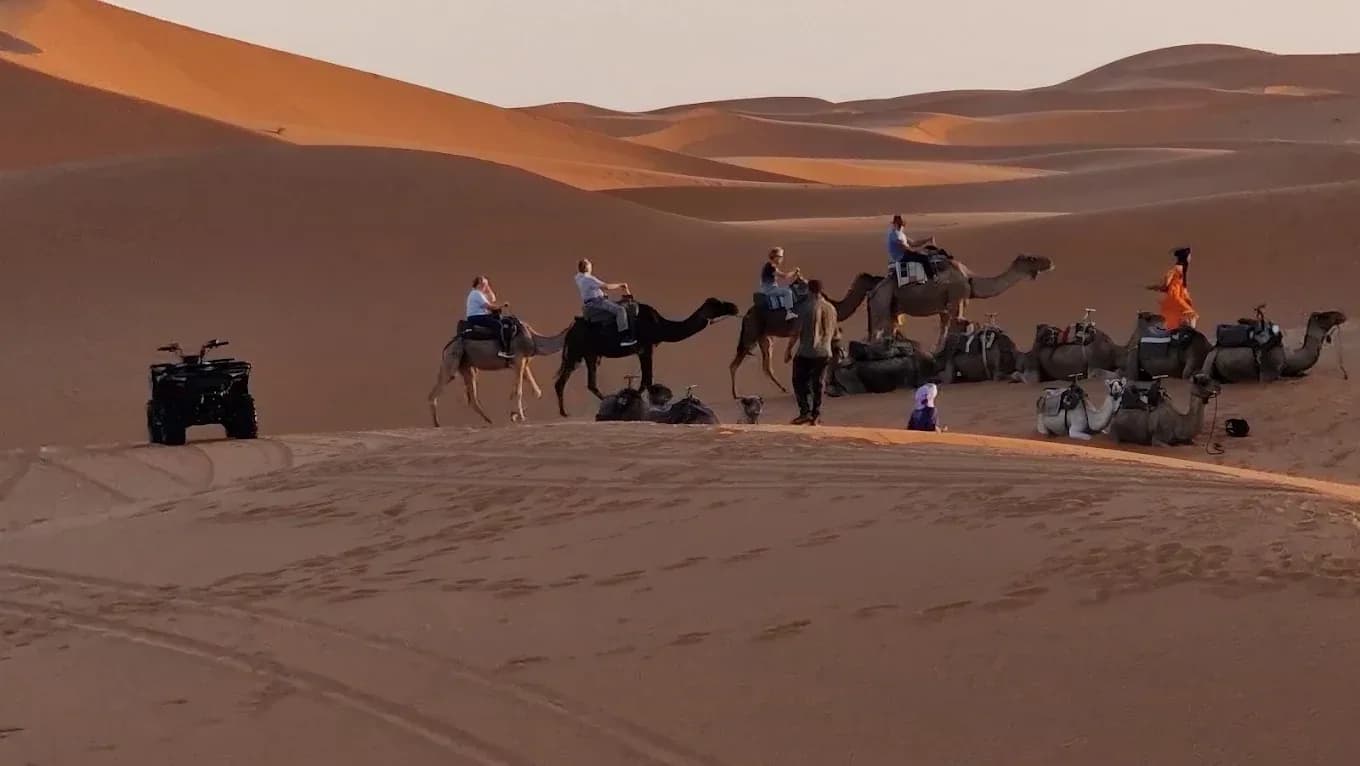
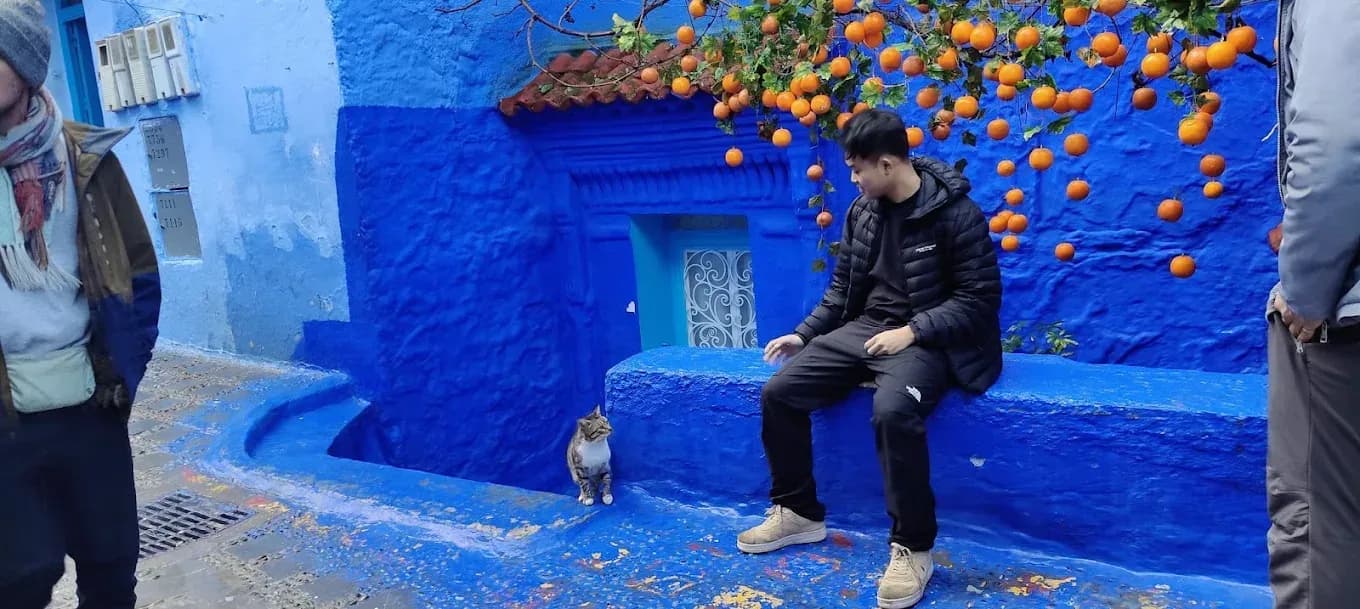
Fez is well placed for continuing your trip. To the north, about four hours by road, is Chefchaouen, the blue town of the Rif: you can do it with our 2-day trip from Fez to Chefchaouen, with a night in the town. To the south, through the Middle Atlas and the cedar forests of Ifrane and Azrou, you reach the Sahara. The 3-day trip from Fez to Merzouga ends in Marrakech, a practical way to cross the country without retracing your steps. The day from Fez to Merzouga is long, seven to eight hours with stops, and it is worth knowing that beforehand.
For a whole week, there is our Morocco in 7 days itinerary. If you are interested in the imperial cities and history, have a look at our selection of cultural trips.
Practical tips for visiting Fez
Finding your way in the medina
Fez is more of a maze than Marrakech. Phone maps help, but inside the medina they often fail, because the streets are too narrow for GPS to be accurate. Use Talaa Kebira and Talaa Seghira as reference points and, if you get lost, ask a shopkeeper sitting in his shop or a family, not whoever is following you offering to be your guide. Children who show you the way will ask for a coin when you get there.
Official guides
We recommend an official guide at least for the first day. They carry an accreditation they can show you if you ask. On the private tours we organise we always include one, with a Spanish-speaking guide, because it completely changes the visit.
Money
In the medina almost everything is paid in cash. Carry dirhams in small notes for tips, the tannery terraces and small purchases.
Where to stay
A riad inside the medina, near Bab Bou Jeloud or Batha, lets you get around on foot and is easy to find when you arrive. Many riads in Fez were once the homes of merchant families, with huge courtyards and lots of carved wood. As in Marrakech, the car can't reach the door and someone from the riad comes to meet you with a handcart.
Shoes and clothing
Cobbled streets, slopes and steps: wear comfortable closed shoes with a good sole. In winter the stone gets slippery when it rains. Clothes that cover shoulders and knees are the most appropriate in Fez. The full packing list is in what to pack for Morocco.
When to go
Spring and autumn are the best seasons for walking the medina. In summer Fez is very hot because it sits in a valley, and there's no breeze inside the lanes; the smells are also stronger. In winter there is some rain and the nights are cold, although many days are sunny and there are fewer people. We explain it month by month in the best time to visit Morocco.
Plan your visit to Fez
We can arrange a day with an official Spanish-speaking guide, a well-located riad and the onward trip to Chefchaouen or the desert. Write to us through the contact page, tell us how many nights you have in Fez and where your trip goes next, and we'll design the route with you.
Frequently asked questions
Do you need a guide to visit the Fez medina?
It isn't compulsory, but we recommend it here more than in any other city in the country. The medina has thousands of dead-end lanes and very few straight streets. With an official guide you see in half a day what would take you two days to find on your own, you understand what you are looking at and nobody else offers to walk you around on the way.
How many days do I need to see Fez?
With one full day and a guide you cover the main sights of Fez el Bali. Two days let you go without rushing and see Fez el Jdid, the Mellah and the viewpoints at sunset. With a third you can go to Meknes and Volubilis. Fez is also a good base for heading to Chefchaouen or to the Merzouga dunes.
Do the Fez tanneries smell a lot?
Yes, and more so in summer and at midday, when the heat strengthens the smell of the hides and dyes. On the shop terraces they give you a sprig of mint to hold under your nose. Most people are bothered for the first few minutes and then get used to it. In the morning there is more work going on in the pits and it is cooler.
How do you get to Fez?
Fez has an international airport, Fès-Saïss, with flights from several European cities. The train links it with Tangier, Rabat and Casablanca. From Marrakech it is about seven hours by train or car, which is why many travellers prefer to link the two cities through the south, with a night in the desert in between.